
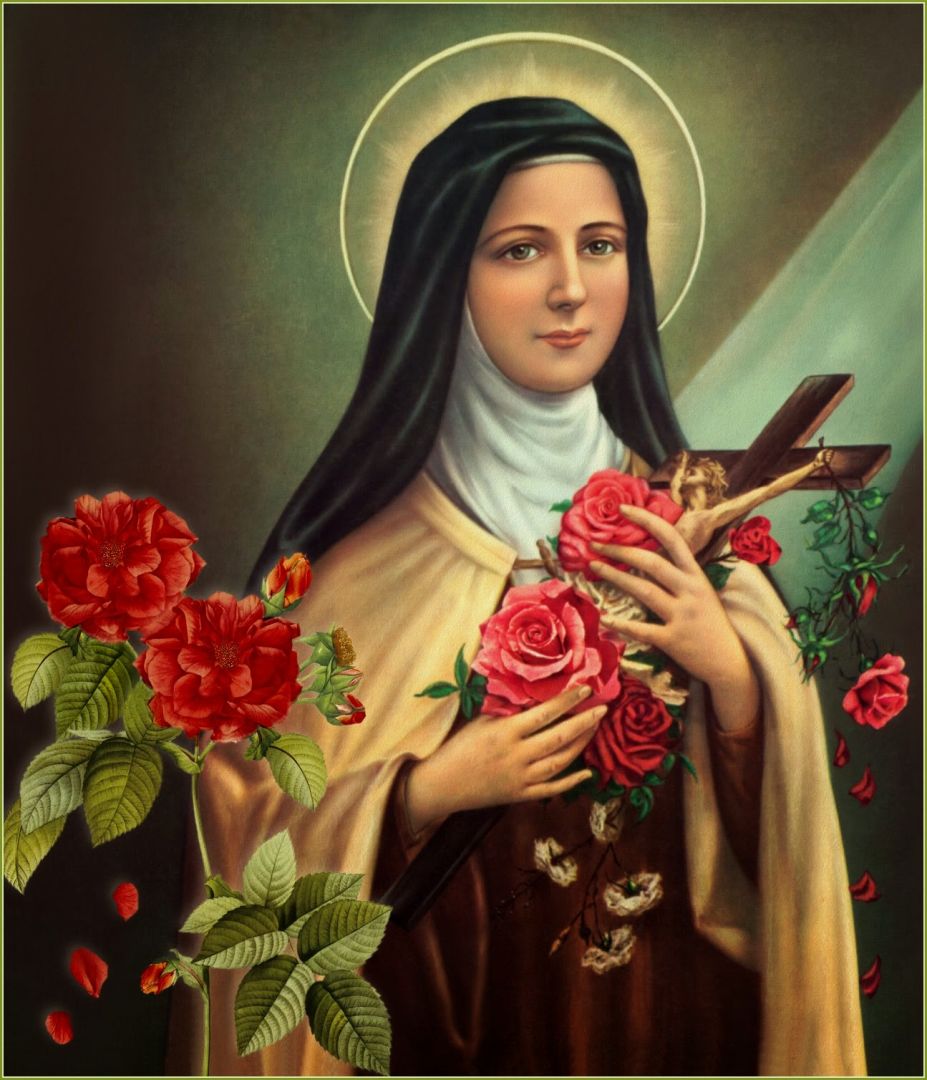
 This week we begin the month of October. Beginning on Thursday with the feast of St. Thérèse of Lisieux (1873–1897), known as the “Little Flower” or Thérèse of the Child Jesus and the Holy Face, this iconic saint lived a short, outwardly ordinary life that has inspired millions through her “Little Way” of spiritual childhood—finding holiness in small, everyday acts done with great love and childlike trust in God’s mercy.
Born Marie Françoise-Thérèse Martin on January 2, 1873, in Alençon, France, she was the youngest of nine children (four of whom died young) of Louis and Zélie Martin, both later canonized as saints. The family was devout and affectionate. Her mother died of breast cancer when Thérèse was four, after which the family moved to Lisieux. She was raised largely by her older sisters in a loving but sensitive environment.
As a child she was lively yet prone to sensitivity and scruples. At age 10 she suffered a serious illness with neurological symptoms, from which she recovered after a reported vision of the Virgin Mary smiling at her. A pivotal “conversion” occurred on Christmas 1886: after a minor family remark, she experienced a sudden maturity and resolve to overcome self-centeredness. Drawn to religious life early, she entered the Carmelite convent in Lisieux at age 15 (April 9, 1888) after overcoming age barriers, including a bold personal plea to Pope Leo XIII during a pilgrimage to Rome. Two of her sisters were already there; a third joined later. She took the name Thérèse of the Child Jesus and the Holy Face. Life in the cloister was austere—simple food, hard work, limited heat—and marked by ordinary tensions and her own struggles with dryness in prayer.
In her final years she developed tuberculosis. From 1896 she endured intense physical suffering and a profound “night of faith” with doubts, yet she offered everything in love. She wrote her autobiography (Story of a Soul / Histoire d’une âme) under obedience, describing her discovery of the “Little Way.” She died on September 30, 1897, at age 24, promising to “spend my heaven doing good on earth” and sending a “shower of roses.” Rapidly popular after the posthumous publication of her writings, she was beatified in 1923, canonized in 1925 by Pope Pius XI (one of the fastest processes), named patroness of missions in 1927, and declared a Doctor of the Church by Pope John Paul II in 1997—the youngest and one of only a few women to receive the title.
Thérèse realized she could not climb a steep stairway of heroic perfection through her own strength. Instead, she sought a “little way… very short and very straight,” remaining small like a child who trusts completely in a loving Father and is lifted by His arms (drawing on Scripture such as “Whoever is a little one, let him come to me”). Holiness consists in doing ordinary duties—chores, patience with difficult people, small sacrifices, hidden acts of charity—with great love, accepting one’s weaknesses without discouragement, and relying on God’s merciful love rather than personal merit. She summarized her vocation simply: “My vocation is love.” She wanted to love Jesus and make Him loved, offering even the smallest moments. This spirituality is practical, accessible to everyone regardless of state in life, and always centred on confidence that, Jesus is close to us.
In a world still marked by achievement culture, constant digital noise, comparison via social media, anxiety, perfectionism, loneliness, and the pressure to do something “grand,” Thérèse’s message remains strikingly relevant. Most lives are made of ordinary moments. She shows that value lies not in viral success, impressive résumés, or visible impact, but in the love poured into small, faithful acts—answering an email kindly, caring for family, performing routine work mindfully, or offering a quiet prayer. This liberates people from burnout and the sense that only the extraordinary counts.
She lived through personal losses, illness, spiritual dryness, and hidden trials while maintaining radical confidence in God’s mercy. In 2026, facing ongoing global challenges, mental health struggles, or personal setbacks, her example encourages surrender without despair: holiness matures in darkness and fidelity, not constant consolation.
Her focus on the present moment and small duties aligns with modern insights into mindfulness and gratitude, while grounding them in relationship with God and neighbour. It counters distraction and materialism by finding meaning in the Anyone—parents, workers, students, the elderly, those with limited resources or health—can follow the Little Way. It democratizes holiness and has influenced figures from Mother Teresa (“do small things with great love”) to contemporary spiritual writers and popes. Pope Francis highlighted her “little greatness” and timely witness against individualism and superficiality.
Thérèse’s hidden life produced a global “shower of roses” of intercession and inspiration. Reading Story of a Soul, practicing small acts of love each day, and cultivating childlike trust remain practical ways to live her spirit now. Her life demonstrates that an ordinary existence offered fully to love can have extraordinary and lasting fruit. A special mass in honour of St. Thérèse of Lisieux will take place on Thursday October 1st in Abbeyleix Parish Church, where the blessing of roses and distribution to those who gather will take place.
May we all know that our God indeed remains close to all our needs.