
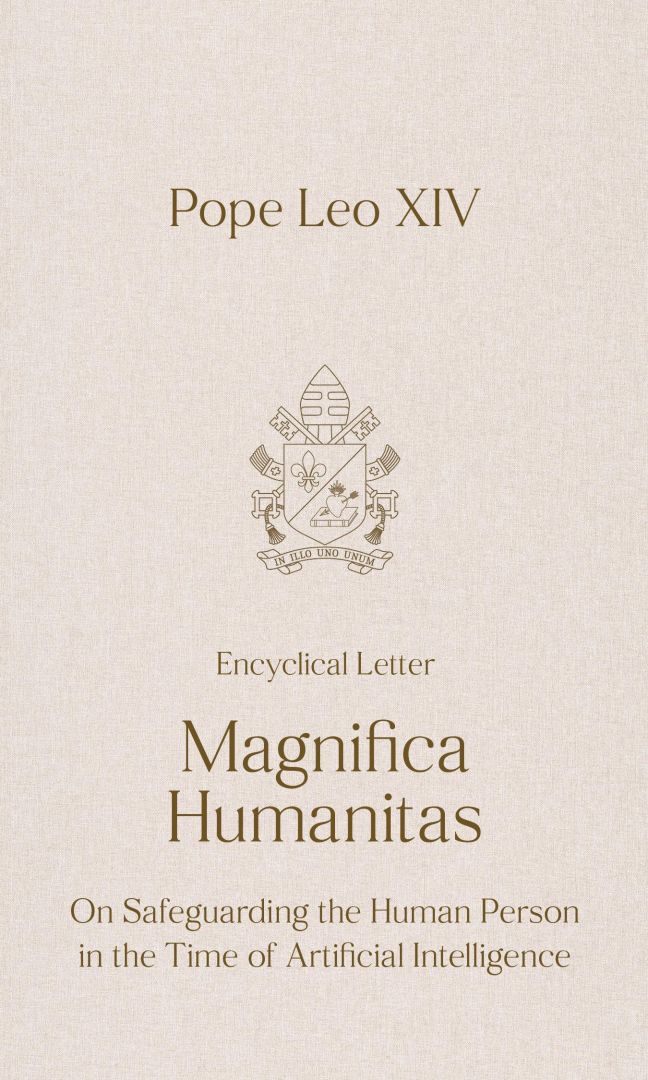
 Pope Leo XIV, recently published the first encyclical, major teaching letter, of his papacy. The letter, Magnifica Humanitas (The Grandeur of Humanity) is aimed at safeguarding humanity at a time of artificial intelligence. At its heart is an appeal to all people of good will to work together to ensure that AI will be developed and used in ways that promote ‘human flourishing’ and help us to build a better and more just world. At this moment in time, the human family is facing a ‘pivotal choice’ and Pope Leo is calling on the global community in all its manifestations – international organisations, governments, commercial companies, scientists and technology specialists, educators, citizens, parents and consumers – to work together to ensure that those who are driving the development of the technology are truly open about what they are doing and are subject to oversight and accountability.
Pope Leo observes that “most people are watching and waiting, observing from afar and merely hoping for the best.” He insists that crucial questions cannot be avoided: “Where are we going? Toward what goal do we wish to orient ourselves? What direction should we choose as people and as a human community?”.
The Pope is inviting us to think about the values, traditions, social customs and practises that help the human community to flourish. Human flourishing requires us to be attentive to the factors that promote the well-being of individuals, that protect and support the human communities where people live and grow together, that remind us to have an inclusive understanding of the human family where the dignity of the most vulnerable is defended and valued and where we live in peace with one another. In recent years, we are also increasingly aware that human flourishing will not be sustainable if we do not live in harmony with our natural ecological environment. This reflection becomes even more urgent in the context of AI which it is acknowledged is set to be highly disruptive of our existing political, economic, labour and social dynamics.
In terms of the impact on individuals, Pope Leo highlights the risk that overreliance on AI will weaken and impair our capacity for critical refection, will blind us to many of the biases and interests embodied in data sets that condition the outcomes of Generative AI platforms, and that the seemingly human voice and sensitivity of many chatbots will undermine our capacity or appetite for true human friendships and relationships. “They may imitate language, behaviour and analytical skills, or even simulate empathy and understanding, but they do not understand what they produce, for they lack the affective, relational and spiritual perspective through which human beings grow in wisdom.”
The human community is suffering a crisis of trust where the mixture of false news and deep fakes is worsening existing patterns of polarisation and undermining the capacity of people to communicate and build good relationships. In a context where AI is already worsening these possibilities, the Holy Father encourages all people to renew their commitment “to transparency in communication and the honest pursuit of facts.” He invites parents, educators and the broader community to be especially vigilant in caring for the young. “Today, accompanying children and young people in using technology for developing responsible relationships, helping them to recognize the risks and choose what fosters inner freedom, is a concrete form of charity and will safeguard their dignity.”
In a world where inequality is already embedded in ‘structures of sin’ – unfair economic and political systems which perpetuate poverty and exclusion – the Pope invites us to be alert to the capacity of AI to exacerbate these injustices. The uneven distribution of the wealth generated by technology and the threat it poses to the employment of many workers must be acknowledged. “To think that new technologies will automatically benefit everyone is to ignore the evidence. Unless transformations at the design stage prioritize the prevention of new and further disparities, technological progress will inevitably produce structural inequalities. Today, justice requires access to the benefits of innovation, including care, knowledge, tools and opportunities.”
Pope Leo encourages politicians and economists to be particularly attentive to prepare for a relatively immediate future where many workers across all sectors risk being replaced by machines with huge impacts for their well-being and that of families. This is not just a matter of the economic consequences “since work is not merely a source of income but a crucial sphere in which identity is formed, friendships and relationships are forged, practical responsibilities are learned and one’s vocation is discerned.” Artificial Intelligence now demands to be disarmed, freed from logics that turn it into an instrument of domination, exclusion and death,” he added.
The pope invoked J.R.R. Tolkien’s Lord of the Rings character Gandalf as he urged people to do their part to build a “civilization of love” amid the threat of AI. He quoted the wizard saying in The Return of the King: “It is not our part to master all the tides of the world, but to do what is in us for the succour of those years wherein we are set, uprooting the evil in the fields that we know, so that those who live after may have clean earth to till.” Leo wrote that the civilisation of love “will not arise from a single or spectacular gesture, but from the sum total of small and steadfast acts of fidelity that serve as a bulwark against dehumanization”. This is a wonderful document of both hope and challenge for the times we live.