
 The early Irish saints refer primarily to the holy men and women who lived during the period of early Christian Ireland, roughly from the 5th to the 8th centuries (with roots in the late 4th century). This era, often called the time of Celtic Christianity, saw Ireland transform from a largely pagan society into a major centre of monasticism, learning, and missionary activity. A time when Ireland was referred to as an “Island of Saints and Scholars.” Christianity arrived in Ireland toward the end of the 4th century, likely through trade contacts with the Roman Empire and early missionaries. There were already some Christians present before the most famous figures emerged. In 431 AD, Pope Celestine I sent Bishop Palladius to minister to “the Scots believing in Christ” (referring to Irish Christians), marking the first documented papal mission. However, the figure who dominated subsequent tradition and is credited with the widespread conversion of Ireland is St. Patrick.
Early Irish Christianity developed a strong monastic focus rather than a strictly diocesan (bishop-centered) structure common elsewhere in the West. Monasteries became centres of education, manuscript production, art and austere spiritual life, influenced by Eastern Desert Fathers traditions. Many Irish saints were missionaries who travelled to Scotland, England, and continental Europe, helping preserve classical learning during the early Middle Ages and evangelizing pagan regions.
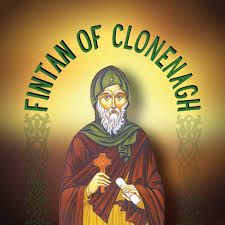
Saint Fintan of Clonenagh, also known as Fintan of Laois, is the saint most closely associated with County Laois, historically Leix or Laoighis, Ireland. He is often called the “Father of the Irish Monks” due to his influential role in early Irish monasticism and his promotion of austere ascetic practices. Fintan was born around 524–526 AD in Leinster (likely near Clonkeen or in the region that became County Laois), the son of Christian parents named Gabhren (or similar) and Findlath. Coming from a Christian family in an era when Ireland was embracing the faith more fully, he chose a religious path early on.
He received his religious training and formation at the monastery in Terryglass, County Tipperary, under Abbot Columba (Colum) of Terryglass. There, he was deeply shaped by strict penitential practices and a severe monastic rule, which emphasized austerity, prayer, and discipline. After his formation, Fintan initially lived as a hermit in Clonenagh (Cluain Ednech, meaning “ivy meadow” or similar), near modern Mountrath in County Laois, beneath the Slieve Bloom Mountains. Disciples soon gathered around his hermitage due to his reputation for holiness, leading him to become abbot of the community he founded there in the mid-6th century (around the 540s–550s).
The monastery at Clonenagh became renowned for its extreme asceticism. Fintan imposed very strict rules on the monks: no animal products (no meat, milk, butter, etc.), as the community kept no cows. Their diet was meagre—often described as “bread of woody barley and clayey water.” This led to complaints from the monks about the hardship for physical labour. A delegation of local clergy, including St. Canice of Aghaboe, urged Fintan to ease the diet for the community. He relented for the monks but maintained the strict regimen for himself, continuing his severe penances.
Despite or because of these hardships, Clonenagh attracted many monks from across Ireland. It trained notable figures, including St. Comgall (who founded Bangor, influencing Columbanus and the spread of Irish monasticism to Europe). Fintan is credited with helping establish the ascetic tradition in Irish monasticism, sometimes compared to St. Benedict in Ireland. Fintan was famed for extraordinary sanctity, peace, compassion, piety, heavenly serenity, prophecy, miracles, and clairvoyance. He lived a life of intense prayer and penance yet was known for serenity amid austerity. His monastery influenced the Céilí Dé reform movement and other strict communities.
He died on February 17, 603 AD (some sources suggest around 594–597, but 603 is widely accepted). His feast day is celebrated on February 17th. Clonenagh remains tied to his memory, with ruins, cross slabs, and St. Fintan’s Well at nearby Cromoge (a holy well site still venerated). He is regarded as one of Laois’s patron saints (alongside others like St. Colman Mac ua Laoise).
(There are multiple Irish saints named Fintan, including Fintan/Munnu of Taghmon, Co. Wexford (d. 635/636), who also has Scottish connections, and others like a later Fintan of Rheinau. The one linked to Laois is specifically Fintan of Clonenagh.) His life exemplifies the rigorous early Irish monastic ideal that helped shape Christianity in Ireland and beyond. In a secular culture, it is important to inform ourselves of the rich tradition Christianity has when it comes to Irish spirituality. I pray, that Saint Fintan, will continue to inspire us to walk a pathway fuelled with a sense of compassion and kindness. St. Fintan, Pray for us.
The early Irish Saints, had a beautiful awareness that God is present in the bits and pieces of our daily lives. Fintan, like Patrick and Bridget, celebrated every moment as an opportunity to embrace God’s presence . While the following prayer is attributed to Saint Patrick, I have no doubt it echoes the rich spirituality enjoyed by Fintan.
Christ with me,
Christ before me,
Christ behind me,
Christ in me,
Christ beneath me,
Christ above me,
Christ on my right,
Christ on my left,
Christ when I lie down,
Christ when I sit down,
Christ when I arise,
Christ in the heart of every man who thinks of me,
Christ in the mouth of everyone who speaks of me,
Christ in every eye that sees me,
Christ in every ear that hears me.