
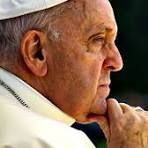
 Visions of the devil, “curiosity” with power, a spiritual crisis involving a keen sense of his own worthlessness and shame, with a certainty that God loved him, Pope Francis will undoubtedly be remembered as one of the greatest mystics of the Catholic Church.
The pontificate of the late Pope Francis was tagged as surprising from the start. In February 2013, Benedict resigned, the first Pope to step aside in nearly six hundred years. Jorge Mario Bergoglio, of Buenos Aires, Argentina, was elected the next month: the first Jesuit Pope, the first Pope from the Americas, and the first to take the name Francis—in emulation of Francis of Assisi, the medieval Italian saint known for “holy poverty.” Once the new Pope assumed office, he lived in the Vatican guesthouse rather than the Apostolic Palace, often rode to papal events in a Fiat instead of a Mercedes-Benz, and brought an anything-goes playfulness to the regular audience outside St. Peter’s. His rapport with the public suggested that he had been changed by his election—that a man known to many Argentinians as dour and circumspect had been infused with what he calls “the joy of the gospel.” His compassion and humility personified the love and mercy of Jesus Christ.
“The Private Diary of Pope Francis” (published November 24, 2026) is a 160-page book of selected excerpts from notes Pope Francis (Jorge Mario Bergoglio) intermittently wrote in a black-covered planner from December 20, 1992 (shortly after becoming auxiliary bishop of Buenos Aires) to August 18, 2024 (about eight months before his death in April 2025). Cardinal Víctor Manuel Fernández (a close Argentine collaborator and prefect of the Dicastery for the Doctrine of the Faith) edited and annotated the volume with theological commentary. Francis had shown him the diary and indicated it could be published if it served for “edification.” The original contained 86 pages of pre-papacy notes and 55 from after his 2013 election; some highly private sections written in symbols were left out. It was released simultaneously in five languages across 94 countries.
The entries emphasize Francis’s inner spiritual life, self-examination, prayer, and pastoral concerns far more than day-to-day Vatican politics or specific events of his papacy. He is often harshly self-critical—acknowledging pride, envy, feelings of inadequacy, and the harm he believed he had caused—while stressing total reliance on God’s mercy. Typical themes include discernment of spirits (in the Jesuit tradition of St. Ignatius), awareness of human weakness, and a desire to stay close to people in their suffering.
Francis describes three occasions when he believed the devil was physically present. Two occurred while he was archbishop of Buenos Aires (once from a car, once during a Mass; he recalled “menacing”/“seductive” eyes or “eyes of fire”). A third, as pope in early 2018 (shortly after a trip to Chile), happened during a meeting with Vatican officials: he heard a raspy, triumphant voice saying something like “Now I’ve gotten everything I wanted,” after which he was able to leave the meeting. He noted frequent demonic attacks and urged vigilance. In a June 7, 2018 entry (amid the Chilean clergy abuse scandal), he wrote that he saw “the entrance to Hell,” with “pagan seduction in full force.” It terrified him; he grabbed a rosary “as a weapon” and thanked God for the help of prayer. He linked the experience to the depth of the scandal and the shame it brought on the Church.
He described a prolonged period of dryness, desolation, and temptation tied to the exercise of power, self-sufficiency, excessive activity, and a fear of treating people like “puppets.” Fernández characterizes it as a kind of “dark night” intensified by worsening health and “assaults of the forces of evil.” Francis overcame it through surrender to God’s mercy; he later reported feeling Jesus’s merciful gaze and receiving interior consolations. “I felt with certainty that the Lord loved me with a predilection. It was a long time during which the Lord showed me the love he has for me, his faithfulness. It felt like a cushion was wrapped around me and saved me from falling apart.”
The crisis is presented as bearing fruit in later documents such as the 2023 exhortation C’est la confiance (on St. Thérèse of Lisieux) and the 2024 encyclical Dilexit nos (on the Sacred Heart. He records positive mystical experiences (God speaking in dreams, a sense of the Lord’s smile). Near the end he reflects again on the devil’s presence across his life and asks the Virgin Mary’s protection. He also refers to his eventual successor (Pope Leo XIV) in positive terms as an “irreproachable” man.
Overall, the published diary portrays a pope who saw himself as a sinner dependent on grace, alert to spiritual warfare, and oriented toward mercy and pastoral closeness. It is framed as spiritual reading rather than a political or chronological memoir. What goes on in the heart and mind of a pope? What if we consider him as a living, breathing human being? Throughout his time at the Vatican, Pope Francis held onto his identity as a mere man called to something far greater than himself, a man with gifts and flaws and desires – just like everybody else. In his personal diary, which he kept for over thirty years, Pope Francis offers an unparalleled and extraordinary insight into his inner life. For anyone who has wanted to understand him, both as a spiritual leader and a fellow human being, his diary is a gift and essential reading.